
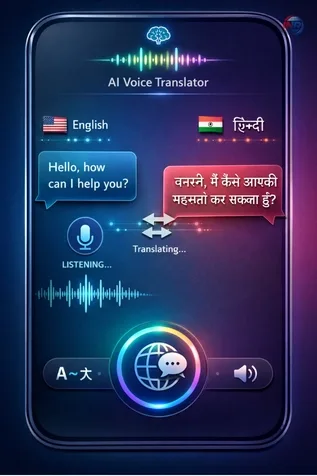
In the era of artificial intelligence, voice assistants have become an integral part of our daily lives. From setting reminders to controlling smart home devices, AI-powered assistants like Google Assistant, Amazon Alexa, and Apple Siri have simplified interactions with technology. However, for a linguistically diverse country like India, where more than 1,600 languages and dialects are spoken, providing an AI voice assistant experience in Indian languages is both a challenge and an opportunity.
- AI Voice Assistants for Indian Languages: The Future of Conversational AI in India explains the latest key context for readers.
- Readers should check the article update date and linked sources where available.
- Related articles and official references are included to help readers explore more.
As more Indians come online, the demand for regional language support is growing rapidly. According to industry reports, over 400 million Indian internet users prefer using regional languages over English for online content consumption. This shift has pushed tech companies and startups to develop AI voice assistants capable of understanding not just standard Indian languages but also local dialects, accents, and code-mixed speech.
Article quality update
Verification note: AI voice assistant support for Indian languages depends on product, app version, region and supported language models.
This article has been reviewed to improve clarity, reduce hype and point readers toward reliable source checks.
Useful official / reference sources
Why Voice Assistants in Indian Languages Are Crucial
1. Digital Inclusion
India’s rural population and low-literacy users often face challenges in accessing digital services. Voice assistants in local languages allow users to interact naturally without needing literacy in English or navigating complex user interfaces.
For instance, a farmer in Uttar Pradesh can ask a voice assistant in Hindi about crop prices or weather forecasts, making technology accessible and empowering communities.
2. Enormous Market Potential
The Indian smart speaker market is growing at a compound annual growth rate (CAGR) of over 30% in 2026. Smart speakers, smartphones, and AI-powered devices with regional language support are driving adoption.
Voice assistants that understand multiple Indian languages provide a competitive advantage, helping companies capture a broader user base.
3. Enhanced User Experience
Voice assistants are most effective when users can communicate naturally. Supporting Indian languages ensures that users don’t feel restricted to English-only commands, making interactions smoother, faster, and more intuitive.
Popular AI Voice Assistants Supporting Indian Languages
Google Assistant
Google Assistant leads the market in multilingual AI support. Currently, it supports:
- Hindi, Tamil, Telugu, Kannada, Bengali, Marathi, Malayalam, Gujarati, Punjabi
- Multilingual understanding, allowing users to switch languages seamlessly in the same conversation.
- Integration with apps like Google Maps, YouTube, and payment services.
Amazon Alexa
Amazon Alexa has begun supporting Hindi, with plans to include more regional languages. Alexa devices in India allow users to:
- Control smart home appliances in Hindi.
- Play music, check weather, and order products via voice commands.
- Enable skills customized for regional needs.
Apple Siri
Apple Siri has limited support for Indian languages but can understand Hindi and occasionally respond in English-Hindi code-mixed speech. Apple continues to improve Siri’s regional language capabilities for Indian users.
Regional Startups
Startups are leading innovation in India by developing localized conversational AI. Examples include:
- Uniphore – Focused on enterprise voice automation in Indian languages.
- Haptik – Provides AI chatbots and voice assistants tailored for regional businesses.
- Rulai India – Offers multilingual virtual assistants for customer support.
These startups address challenges that global AI systems face, such as dialect recognition, cultural context, and code-mixed speech.
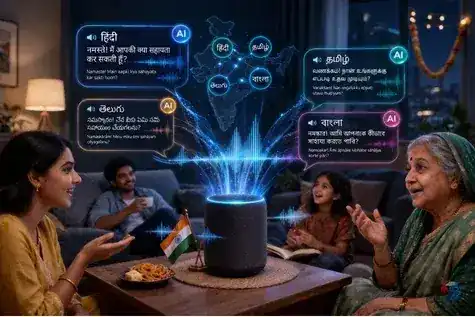
Challenges in Developing Voice Assistants for Indian Languages
1. Diverse Dialects and Accents
Indian languages have multiple dialects and regional variations. Hindi, for example, is spoken differently in Rajasthan, Bihar, and Delhi. AI models must understand these nuances for accurate speech recognition.
2. Code-Mixing and Hinglish
Many Indians naturally mix English and regional languages while speaking. This hybrid speech (like “Play the latest song in Hindi, please”) is difficult for AI to interpret accurately.
3. Data Scarcity
High-quality voice datasets are critical for training AI. For less commonly spoken languages like Assamese, Odia, or Konkani, datasets are limited. Without sufficient data, AI assistants struggle with recognition and context understanding.
4. Contextual Understanding
Understanding cultural context, idioms, and colloquialisms is vital for AI assistants. A command like “Bring me chai” could refer to ordering tea online, showing a recipe, or playing a video about tea, depending on context.
5. Technical Limitations
- Accents, speech speed, and background noise in rural areas affect recognition accuracy.
- Processing voice commands offline is challenging due to device limitations and lack of connectivity in remote areas.
Applications of AI Voice Assistants in India
1. Banking and Financial Services
Voice assistants allow users to perform banking tasks in Hindi and regional languages:
- Check account balance
- Transfer money
- Pay bills
This is particularly helpful for elderly users or those unfamiliar with digital banking interfaces.
2. Healthcare
AI assistants can guide patients through medical instructions, book appointments, and provide health advice in local languages, making healthcare more accessible.
3. Smart Homes
Controlling lights, fans, air conditioners, and security systems via voice in Hindi, Tamil, or Telugu enhances user convenience.
4. Education
Voice assistants help students:
- Learn new concepts in their mother tongue
- Practice language skills
- Access online educational content without literacy barriers
5. E-Commerce and Voice Commerce
Voice-enabled shopping in regional languages allows users to:
- Search products
- Compare prices
- Make purchases
This feature is increasingly popular in Tier 2 and Tier 3 cities.
Market Trends and Growth
- Increasing Multilingual Device Adoption – More smartphones, smart TVs, and smart speakers with regional language support.
- Government Initiatives – Projects like Digital India emphasize inclusivity for regional language users.
- AI and NLP Advancements – Natural Language Processing (NLP) models like IndicBERT and AI4Bharat are making regional language understanding more accurate.
- Rising Startup Ecosystem – Indian startups focusing on regional AI voice assistants are attracting significant investments.
Future of AI Voice Assistants in Indian Languages
1. Multilingual AI Models
Future AI assistants will seamlessly understand and switch between multiple Indian languages and dialects within a single conversation.
2. Localized Services
Voice assistants will offer region-specific suggestions, personalized content, and culturally aware responses, increasing engagement and utility.
3. Offline Functionality
Offline AI voice assistants will empower rural users with limited internet access, bridging the digital divide.
4. Voice Commerce Expansion
Voice-based transactions, shopping, and bookings in regional languages will become mainstream, enabling inclusive digital commerce.
5. Integration with IoT and Smart Cities
As India moves towards smart city infrastructure, voice assistants will integrate with IoT devices to manage transportation, utilities, and public services using regional language commands.
Conclusion
AI voice assistants for Indian languages are transforming the way millions of Indians interact with technology. From improving accessibility and digital inclusion to enhancing everyday convenience, their potential is enormous.
Despite challenges like dialect diversity, code-mixing, and data scarcity, advancements in natural language processing and AI-driven localization are bridging gaps. With increased adoption of multilingual AI models, regional language support will soon become a standard feature, making technology accessible to every corner of India.
For businesses and developers, investing in AI voice assistants for Indian languages is not just a market opportunity—it’s a step towards shaping an inclusive digital India.
Indian News Reporter: Your source for smart, speedy updates!
Frequently Asked Questions
Why are Indian language voice assistants important?
They make digital services easier for users who prefer regional languages instead of English.
Do all voice assistants support Indian languages?
Support varies by product, app version and region, so users should check the official feature list.
Can voice assistants help students?
Yes. They can help with reminders, translations, quick explanations and accessibility, but answers should be verified for accuracy.
